Olympic Phase I
Nimitz’s Operation Plan 4-45, 15 May 45 established the overall mission of his forces as Admiral Halsey took over responsibility for the fleet as follows: “While developing newly captured positions in the approaches to Japan, forces of the Pacific Ocean Areas will extend the sea and air blockade of Japan and will reduce Japanese air, naval and industrial strength in order to lower the Japanese ability and will to resist.”
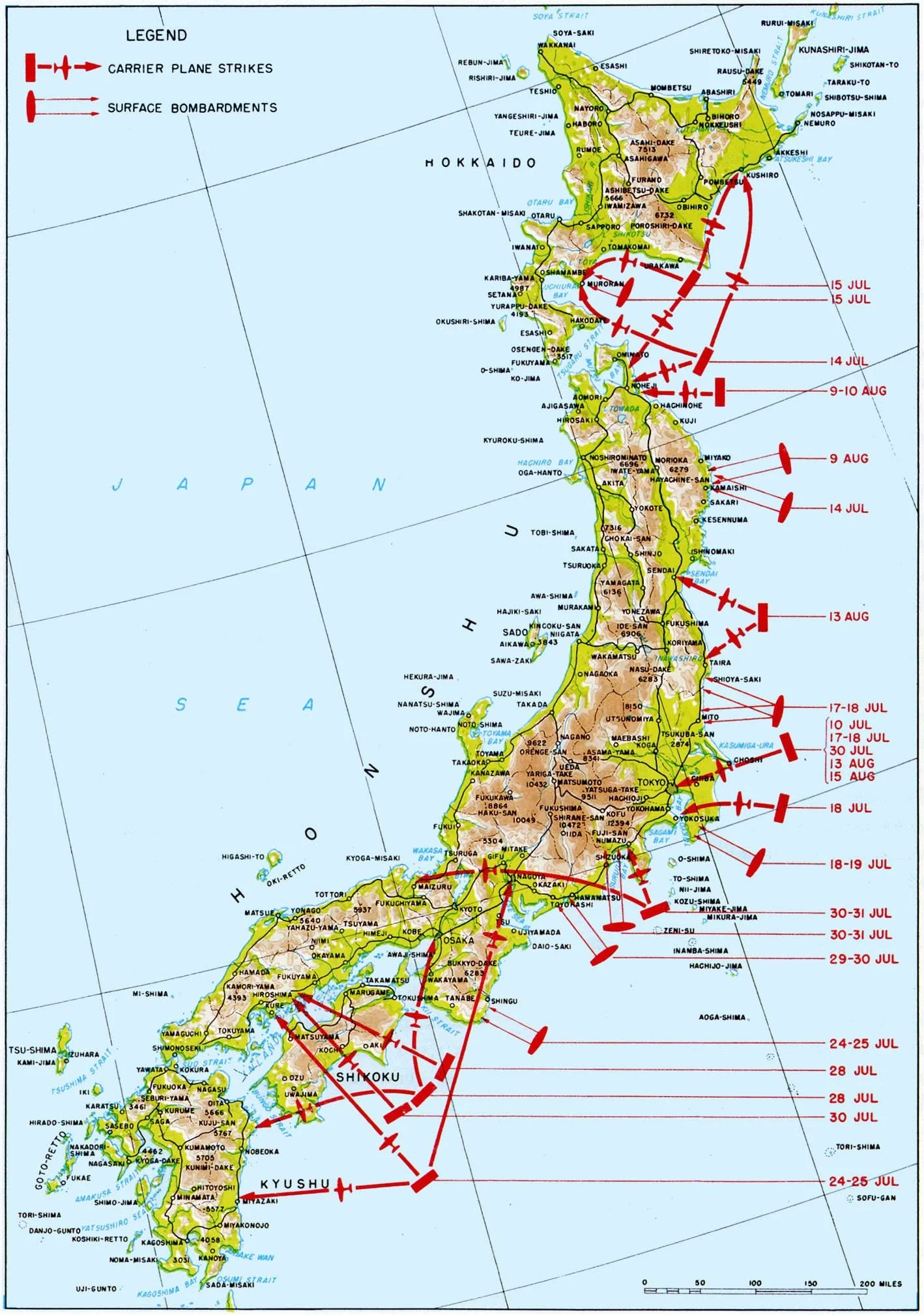
For the Navy, the first phase of Operation Olympic began as the Fast Carrier Task Force (Task Force 38) sortied from Leyte Gulf on 1 July 1945. Its mission was to (1) Attack Japanese naval and air forces, shipping, shipyards, and coast objectives, (2) Cover and support Ryukyus forces, and (3)Protect sea and air communications along the Central Pacific Axis. It would accomplish these objectives by a combination of air strikes, naval bombardments, and anti-shipping sweeps.
For this purpose, major Forces, Groups, and Units in the Third Fleet included:
Task Group 30.2, Radio Deception Group, USS TUCSON
Task Group 30.6, Anti-Submarine Warfare Group A, USS TULAGI
Task Group 30.8, Logistic Support Group, USS DETROIT
Task Group 30.9, Base Service Group
Task Unit 34.8.1, Bombardment Group A, USS MASSACHUSETTS
Task Unit 34.8.2 Bombardment Group B, USS IOWA
Task Group 35.3, Cruiser Division 17, USS PASADENA
Task Group 35.4, Cruiser Division 18, USS TOPEKA
Task Force 37, British Carrier Force, HMS KING GEORGE V
Task Force 38, Fast Carrier Task Force, USS SHANGRI LA
Task Group 38.1, Fast Carrier Group 1, USS BENNINGTON
Task Group 38.3, Fast Carrier Group 3, USS RANDOLPH
Task Group 38.4, Fast Carrier Group 4, USS YORKTOWN
Order of Battle details are included at “Navy at War’s End” “3rd Fleet” page.
Major air strikes were made on:
10 July, Tokyo Area Airfields
14 July, N. Honshu & Hokkaido, Shipping and Airfields
15 July, N. Honshu & Hokkaido, Shipping and Airfields
17 July, Tokyo Area Airfields
18 July, Tokyo Area Airfields-Yokosuka Naval Base
24 July, N. Kyushu, Shikoku, & W. Honshu Airfields & Shipping-Kure Naval Base
25 July, N. Kyushu, Shikoku, & W. Honshu Airfields & Shipping-Nagoya & Osaka
28 July, N. Kyushu, Shikoku, & W. Honshu Airfields & Shipping-Kure Naval Base
30 July, Kobe, Nagoya, Maizuru, S. Tokyo Area Airfields
9 August, N. Honshu Area Airfields
10 August, N. Honshu & Tokyo Area Airfields
13 August, Tokyo Area Airfields & Industry
15 August, Tokyo Area Airfields
Battleship Bombardments were made on:
14 July, Kamaishi
15 July, Muroran
17 July, Hatachi
29 July, Hamamatsu
9 August, Kamaishi
Anti Shipping sweeps by light cruisers and destroyers were made on:
14-15 July, Kamaishi coastal area
18-19 July, Nojima Saki light to Izu Shoto
22-23 July, Sagami Nada & Ogasawaga Gunto
24-25 July, Kii Suido
30-31 July, Suruga Wan
The plan was for Task Force 37 to retire to Manus/Australia and Task Force 38 to retire to Eniwetok (its new forward base) in mid August. In fact, Task Force 38 and portions of the British Pacific Fleet remained in Japanese waters as the surrender became imminent.
The Third Fleet also consisted of units operating under the Command of Admiral Oldendorf that would be transferred to Task Force 95 on 25 July.
Task Group 30.5, Fleet Air Wing 1 at Okinawa
Task Force 32, Combat Ships based at Okinawa and Leyte Gulf
Task Force 33, Fast Cruiser Battle Group with Large Cruisers, Guam and Alaska
Task Force 39, Mine Force based at Okinawa
Task Group 30.5, Fleet Air Wing 1 at Okinawa
Task Unit 30.9.4, Service Force Units at Okinawa
When this change was made Third Fleet was relieved of the specific responsibility for covering the Ryukyus and its primary area of activity was designated as east of the 135th meridian. This permitted Admiral Halsey with the the premium portion of the U.S. Fleet to focus on the destruction of Japan’s war making ability.