Army Air Force Land Based Requirements
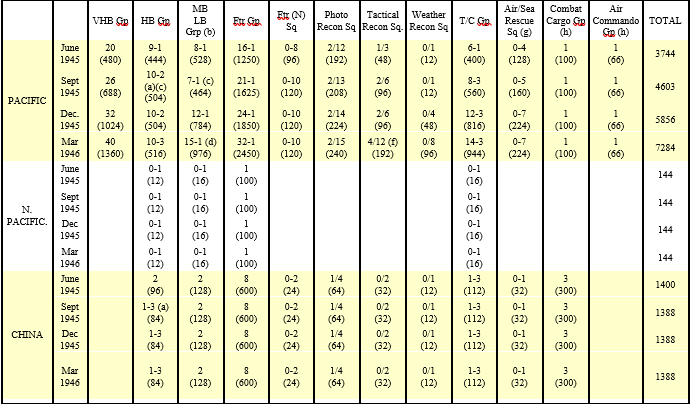
(a) One LAB squadron transferred to Pacific.
(b) M/L/B column includes one LB Gp (Special Pathfinder unit) for USASTAF.
(c) One LB Gp converted to HB Gp (B-32) in September.
(d) One LB Gp in readiness 1 April for deployment to Pacific if necessary.
(e) All Recon units are shown under one heading in JCS 521/12.
(f) Three squadrons in readiness 1 April for deployment to Pacific if necessary.
(g) Air/Sea Rescue units not shown in previous deployments, although personnel for these units were carried in AAF totals.
(h) Combat Cargo and Air Commando shown in footnote to Appendix to Enclosure "B", JCS 521/12.
Note: Increase from 6-8 Fighter Groups in China Theater is accomplished by deactivation of 2 Air Commando Groups and reduction of 2 Fighter groups now in the theater from 4 Squadron Groups to standard 3 Squadron Groups and organization of 2 Groups from 6 Squadrons thus made available.
ANNEX “A”
PROPOSED CHANGES IN ESTIMATED REQUIREMENT FOR ARMY AIR FORCE UNITS
AND AIRCRAFT IN THE WAR AGAINST JAPAN —9 August 1945
Air Force Redeployment Schedule
The primary source for this information is the Army Air Force July 1945 Redeployment/Deployment Forecast—Notes apply to the Pacific Theatre and are informed by JCS 1455 and Maurer.
Higher Headquarters
1. The forecast calls for the inactivation of the Allied Air Force Headquarters in the SWPA. This is consistent with the transfer of the RAF, RAAF, and RNZAF units with responsibilities in the portion of the SWPA transferred to the South East Asia Theatre.
2. No change is planned in the Far East Air Force HQ or its subordinates; 5th, 7th, and 13th Air Forces. 5th and 13th AirForces were planned for OLYMPIC. 5th and 7th Air Forces were planned for CORONET.
3. No change is planned for the Strategic Air Force HQ or its subordinates, 8th Air Force on Okinawa and 20th Air Force on Guam.
4. In August 1945 there were three Bomber Command HQ in the Pacific. One of these will be converted to a Composite Command, likely the VII Bomber Command on Okinawa. V and XIII Bomber commands were included in OLYMPIC plans. V Bomber Command was included in CORONET plans.
5. In August 1945 there were three Fighter Command HQ in the Pacific. No change was planned. VII Fighter Command was on Iwo Jima and formed the fighter component of the 20th Air Force. V and XIII Fighter Commands were included in OLYMPIC Plans.
6. This July 1945 plan called for three European Tactical Air Command HQs to be sent to the Pacific and three Pacific based Bomb Wings to be reorganized at Tactical Air Commands. In the Pacific, this would have been the 308, 309, and 310 Bomb Wings. The three ETO Tactical Air Commands were likely IX, XIX, XXIX. The fourth, the XII Tactical Air Command remained in Germany as part of the occupation. A fifth Tactical Air Command, the XXII, was inactivated in Italy. The XIX Tactical Air Command had departed Germany in July and is included in some (but not all) troop lists for OLYMPIC.
7. The IX Troop Carrier Command was planned to move to the Pacific.
Wing Headquarters
8. By August 1945, there were five B-29 wings in 20 Air Force (58, 73, 313, 314, & 315). 316 Bomb Wing was arriving at Okinawa as a part of the 8th Air Force. Four more B-29 wings (47, 20, 96, & 13) were being organized in the Continental United States (CONUS) from units redeployed from the ETO and MTO.
9. The July 1945 redeployment plan called for three Heavy Bomb Wing headquarters be redeployed to the Pacific. JCS 1455, 9 August 1945, recommended that the heavy bomber units (B-17) not be sent in favor of expansion of existing B-29 units.
10. The July 1945 redeployment plan also called for three Medium Bomb Wing headquarters be redeployed from the ETO to the Pacific. Of the four candidates (42, 97, 98, 99), 99 Bomb Wing was the only one to leave Europe by August 1945.
11. There were four Fighter Wing Headquarters in the Pacific in August 1945. Three of these were serving as air defense headquarters, 7 Fighter Wing in Hawaii and 85 & 86 Fighter Wings in the Philippines. The 301 Fighter Wing was an active P-47 unit on Ie Shima and was to be 8th Air Force’s fighter component.
Two Fighter Wings were to redeploy from Europe, one from the ETO and another from the MTO. The most likely candidates are 100th Fighter Wing from Germany and 306th Fighter Wing from Italy. Both were in the United States by September 1945.
12. In August 1945, the 91st Reconnaissance Wing was assigned to the 5th Air Force. The 90th Reconnaissance was scheduled to move to the Pacific. It had served in the MTO and returned to the USA in April 1945. A USASTAF planning document from August 1945 indicated that the unit was no longer to be assigned to the Strategic Air Forces.
13. In August 1945, two Troop Carrier Wings were assigned to the Pacific. The 322nd was responsible for the regular service routes while the 54th Troop Carrier Wing was responsible for combat operations. Two additional Troop Carrier Wings were to be redeployed to the Pacific. The likely candidates are two from the 52nd, 50th, and 53rd Troop Carrier Wings in the ETO. The 51st Troop Carrier Wing remained in Germany as part of the occupation.
Very Heavy Bomb Groups (B-29)
14. The July plan called for a full VHB build out of 10 B-29 Wings consisting of 40 B-29 and 1 Composite Group with 161 B-29 squadrons. Four Heavy Bomb Wings and Sixteen Heavy Bomb Groups were units redeployed from Europe and converted to B-29 units. 30 of the squadrons were to activated in the Pacific to increase the size of the first 30 groups from 3 to 4 squadrons each. The 509 Composite Group, which delivered the atomic bomb had one Bomb Squadron and one Troop Carrier Squadron.
The following units were arriving at Kadena from the USA for the 8th Air Force as the war was ending. The primary source for this information is https://www.scribd.com/document/ 37161330/Movement-of-USASTAF-Combat-Forces?v=0.234.
316 Bomb Wing (VH) Kadena ETA 14-23 Aug 45
333 Bomb Group (VH) Kadena 4-Aug-45
346 Bomb Group (VH) Kadena 7-Aug-45
382 Bomb Group (VH) Kadena 8-Sep-45
383 Bomb Group (VH) Kadena 12-Sep-45
The following units were redeploying from Europe at wars end according to the following schedule.
47 Bomb Wing (VH) Bolo Oct 45
489 Bomb Group (VH) Bolo Flight echelon ready 15 Sep
98 Bomb Group (VH) Bolo Flight echelon ready 15 Sep
376 Bomb Group (VH) Bolo Flight echelon ready 15 Oct
450 Bomb Group (VH) Bolo Flight echelon ready 15 Oct
20 Bomb Wing (VH) Futema Dec-45
449 Bomb Group (VH) Futema Flight echelon ready 15 Nov
485 Bomb Group (VH) Futema Flight echelon ready 15 Nov
44 Bomb Group (VH) Futema Flight echelon ready 15 Dec
93 Bomb Group (VH) Futema Flight echelon ready 15 Dec
96 Bomb Wing (VH) Okinawa Jan-46
448 Bomb Group (VH) Okinawa Flight echelon ready 15 Jan
458 Bomb Group (VH) Okinawa Flight echelon ready 15 Jan
466 Bomb Group (VH) Okinawa Flight echelon ready 15 Jan
467 Bomb Group (VH) Okinawa Flight echelon ready 15 Jan
13 Bomb Wing (VH) Okinawa Feb-46
301 Bomb Group (VH) Okinawa Feb-46
454 Bomb Group (VH) Okinawa Feb-46
456 Bomb Group (VH) Okinawa Feb-46
492 Bomb Group (VH) Okinawa Feb-46
Heavy Bomb Groups (B-17, B-24, B-32)
15. In June 1945 there were 9 Heavy Bomb Groups in the Pacific, all equipped with B-24s. Four were in the 5th Air Force (22, 43, 90, 380); 3 were in the 7th Air Force (11, 30, 494); and 2 were in the 13th Air Force (5, 307). In addition the 13th Air Force’s, 868th Bomb Squadron, was categorized as a Low Altitude Bomb (LAB) unit-specializing in night antishipping operations. The 5th Air Force’s 63rd Bomb Squadron was part of the 43rd Bomb Group and similarly equipped. In July 1945 another LAB unit, the 383rd Bomb Squadron joined the 7th Air Force’s 494th Bomb Group from China.
The July 1945 redeployment plan included 4 B-17 Groups redeploying from Europe to the Pacific, down from earlier plans. An analysis of Maurer suggests these groups were the 447th, 486th, 487th, and 490th Bomb Groups. JCS 1455, 9 August 1945, considered adding three additional B-17 groups, but then recommended that the heavy bomber units (B-17) not be sent in favor of expansion of existing B-29 units from three to four squadrons and from eight to nine aircraft per squadron.
The 36th Bomb Squadron (H) is a special case. The July plan called for a B-24 Radar Countermeasures Unit to be sent from the ETO to the Pacific. While none of the Pacific planning documents include this unit, it may be that deployment of this RCM unit was shielded by security considerations.
There was also the special case of the 312th Bomb Group. In August it was in the process of converting from A-20 to B-32 and becoming the tenth heavy (or Very Heavy) Bomb Group assigned to the FEAF. The B-32 was the bomber the that was developed and produced in limited numbers as a hedge against failure of the B-29 program. As the bombers were more capable than his B-24s, General Kenney asked they be sent to the FEAF. He used them to equip the 312 Bomb Group.
My best guess of JCS 1455’s identified requirements for ten groups (22,43,90,312,380,11,30,494,5,307) and three squadrons (868,373,36) of heavy bombers in the Pacific is based on the reasoning above.
Medium and Light Bomb Groups (B-25, A-20, A-26)
16. In June 1945 there were four B-25 Medium Bomb Groups in the Pacific (38, 41, 42, 345), three A-20 Light Bomb Groups (3, 312, 417), and the first redeployed group, the 319th Light Bomb Group with A-26 aircraft. The 42nd Bomb Group was unusual in that it had five squadrons assigned. As noted above the 312th Bomb Group was subsequently reorganized as a heavy bomb group.
In July 1945, there were 13 Medium/Light Bomb Groups in the ETO (17, 320, 322, 323, 344, 386, 387, 394, 391, 397, 409, 416, 417) and four more in the MTO (47, 310, 321,340). These groups had initially been equipped with B-26 (ETO), B-25 (MTO), and A-20 aircraft. Seven of the ETO units were to be redeployed to the Pacific, two by direct redeployment to the Pacific and five through the USA. The groups retained to garrison Europe retained the B-26 inventory.
The 47th Bomb Group (L) was to be redeployed through the USA and trained as a pathfinder group for the Strategic Air Force. It left Italy on 24 June 1945 and was at Seymour Johnson Field, NC when war ended.
One MTO B-25 Group, the 340th, was to be redeployed through the USA. It arrived at Seymour Johnson Field, NC 9 Aug 45. The other MTO Medium Bomb Groups were inactivated in Italy.
At the end of the European War five Army Air Force Groups were flying the A-26; these were the first five Medium/Light groups to leave the theatre and presumably they were the five groups on the redeployment schedule. The first set of three was to go through the USA. They (386, 409,415) were at Seymour Johnson Field, NC in August 1945. The last two (416, 391) were to depart for direct redeployment in August.
JCS 1455 included a medium group in its requirements list that was not on the redeployment schedule. Concurrently, it did not account for the 477th Composite Group, a unit that had been a Medium Bomb Group until June 1945, and was on the July 45 deployment schedule. The African American unit with two Medium Bomb Squadrons and the redeployed 99th Fighter Squadron was to be in the Pacific by November 1945.
Fighter Groups (P-38, P-47, P-51, P-80)
17. In August 1945 there were 16 Fighter Groups in the Pacific. Six Groups were in the 5th Air Force (8, 35, 49, 58, 348, 475). Two Groups were in the 13th Air Force (18, 347). Three Groups were in the 301st Fighter Wing on Okinawa (318, 413, 507). Four groups were in the VII Fighter Command on Iwo Jima (21, 15, 506, 414). The 508th Fighter Group was in Hawaii. P-38s equipped five groups (8, 49, 475, 18, 347). P-47s equipped six groups (58, 318, 413, 507, 508, 414). P-51s equipped five groups (35, 348, 15, 21, 506). The 348th Fighter Group was unique in that it was organized with four squadrons. The 58th Fighter Group was unique in that the 201st Mexican Squadron was attached as a fourth operating squadron. The 3rd Air Commando Group, a composite unit with two P-51 squadrons and a C-47 squadron was in the Pacific.
JCS 1455 called for a doubling of the number of Fighter Groups to a total of 32; 15 groups were to be redeployed from the ETO and MTO. The additional group, that was to come directly from the USA, was the 412th Fighter Group, AAF’s first group equipped with the P-80 jet fighter.
In August 1945 there were 10 Fighter Groups in the MTO (79, 57, 350, 31, 52, 1, 14, 82, 325 & 332). Of the three P-47 Groups (79, 57, & 350), the 79th transferred to the ETO for occupation duty and the 57th and 350th were to be redeployed directly to the Pacific. Of the four P-51 Groups (31, 52, 325, & 332) the 31st and 52nd were at Drew Field in Florida by August 1945 and the 99th Fighter Squadron of the 332nd Fighter Group was at Goodman Field, KY by 22 June 1945. The other P-51 squadrons were inactivated in the USA in October 1945. All three P-38 Groups(1, 14, 82) were inactivated in Italy.
In August 1945 there were 18 P-47 Groups, 16 P-51 Groups, and 1 P-38 Group in the ETO. Nine P-47 Groups and one P-51 Group were to redeploy to the Pacific.
The 370th Fighter Group seems the most likely P-51 group based on Maurer. It was described differently than all the other P-51 groups in the ETO. Though the guess is inferential; it was the first to start movement to the USA, and it was inactivated the same day as almost all other redeployment units, November 7, 1945.
Two ETO Fighter Groups (50 & 358) were to be redeployed to serve with the Strategic Air Force. The units arrived at La Junta, CO in early August and were to be ready to deploy to the Pacific by 1 October. The July redeployment forecast anticipated that these groups would have converted from P-47s to P-51s while at La Junta.
The remaining seven ETO P-47 Fighter Groups (367, 405, 404, 365, 373, 362, 48), presumed to be the redeploying units, left Europe between July and September 1945. Four of these units were to deploy directly to the Pacific. Other ETO P-47 units left later.
Finally, the requirements presented in JCS 1455 included 32 Fighter Groups, one more Fighter Group than planned in the July redeployment schedule. The 31 groups provided in the redeployment schedule included, 16 in the Pacific, 10 from the ETO, 4 from the MTO, and 1 from the USA.
Night Fighter Squadrons
18. In August 1945 there were 8 Night Fighter Squadrons in the Pacific (6, 418, 419, 421, 547, 548, 549, 550). Two additional squadrons were to be redeployed from Europe, one from the ETO and another from the MTO, both by direct deployment. These likely were the 414th and 425th Night Fighter Squadrons; both left Europe in early August. Of the six night fighter squadrons in Europe, three stayed into 1946 and the fourth, the 422nd left in late September and was likely the unit the redeployment plan specified would be converted into a light weather squadron.
Reconnaissance Groups and Squadrons
19. In August 1945 there were eight F-5 Photo Recon squadrons in the Pacific. The 4th Recon Group was assigned to the 13th Air Force with two F-5 Photo Recon Squadrons. The 6th Recon Group was assigned to the 5th Air Force with four F-5 Photo Recon Squadrons. Two independent F-5 squadrons were on Guam and Ie Shima and were/would be assigned to the 20th and 8th Air Forces. The redeployment plan called for three additional Photo Recon squadrons in the Pacific, two squadrons with F-5 aircraft and one with P-80s. The two F-5 squadrons were to deploy directly. The 39th Photo Squadron was equipped with P-80s by 1946, so that is likely the P-80 squadron to be redeployed. The 30th Photo Squadron left Germany in July and fits the pattern of other redeployed units as described in Maurer. The 33rd Photo Squadron left Germany in August.
20. In August 1945 the 71st Tactical Recon Group was the only Tactical Recon Group in the Pacific. It had a unique fixed organization with two F-6 squadrons and a B-25 squadron. The July redeployment schedule provided three additional Tactical Recon Groups from Europe. There were four Tactical Recon Groups in the ETO (10, 67, 69, 363). Of the Tactical Recon Groups, the 10th Recon Group remained in the occupation force leaving the 67th,69th, & 363rd to be redeployed to the Pacific, one directly.
21. In August 1945 there were eleven Tactical Recon Squadrons in Europe (10, 12, 15, 22, 31, 107, 108, 111, 160, 161, 162). The July plan called for nine of these to redeploy to the Pacific, one group with three squadrons directly. It is likely that the three squadrons of the 67th Tactical Recon Group (107,109,161) were in the process of a direct deployment when the war ended. The 69th Tactical Recon Group and five squadrons (10, 15, 22, 31, 162) were at Drew Field, FL by 4 August 1945.
The 363rd Tactical Recon Group and one squadron (160) was left behind in Germany when the Pacific war ended with the garrison’s 10th Tactical Recon Group and two squadrons (12, 111). Ultimately the 12th and 160th remained in Germany in 1946.
Transport Units C-47, C-46
22. In August 1945 there were six Troop Carrier Groups (317, 374, 375, 403, 433, 419) and twenty-six Troop Carrier Squadrons in the Pacific. The 419th Troop Carrier Group was unique in that no squadrons were assigned; the unit ran transportation terminals in the Central Pacific. The 403rd Troop Carrier Group was unusual in that it had an extra squadron assigned. Four independent squadrons were in the Central Pacific (9, 19, 311, & 316). The 320th Troop Carrier Squadron was as assigned to the 509 Composite Group.
The redeployment plan called for eight Troop Carrier Groups and thirty-four Troop Carrier Squadrons to be redeployed from the ETO to the Pacific. The full build out was to be the fourteen Troop Carrier Groups with sixty Troop Carrier Squadrons.
The first two redeployed squadrons (44, 45) came from the 316th Troop Carrier Group, which returned to the USA in May 1945. The two squadrons were to be part of the Strategic Air Force and came out as far as Hawaii in August and September of 1945.
The July redeployment plan recognized 14 Troop Carrier Groups in Europe; two were equipped with C-46 and the remainder with C-47. The two C-46 Troop Carrier Groups (313, 349) were to redeploy directly to the Pacific; the remaining six groups were to redeploy via the USA. By August 1945, five of those groups were at Baer Field, IN and one was enroute (434, 435,436, 437, 439, 438).
23. The 2nd Combat Cargo Group, equipped with C-46, was in the Pacific in August 1945. No changes were contemplated in JCS 1455.
24. The 3rd Air Commando Group, with two P-51 squadrons and the 318th Troop Carriers (Commando) Squadron was in the Pacific in August 1945. No changes were contemplated in JCS 1455. This C-47 is not included in the discussion in section 22 above.
Air Sea Rescue Squadrons
25. The Army Air Force Emergency Rescue Squadrons had an unusual mix of 12 OA-10, 8 B-17, 4 C-47 and 8 L-5 aircraft. Four squadrons served in the Pacific (2,3,4,6), two in China (7, 8), and one each in the MTO (1) and ETO (5). Three squadrons were to be redeployed to the Pacific, one each from the MTO and ETO plus the 7th from China. Three squadrons (4, 5, 7) would be assigned to the Strategic Air Force. Two squadrons (3, 6) were assigned to OLYMPIC.
Weather Squadrons
26. JCS 1455 identified the requirement for 8 Weather Recon Squadrons in the Pacific. In August 1945 only the 55th Recon Squadron (Long Range Weather), equipped with B-24s filled that role. The July redeployment plan called for a full complement of one Very Long Range Squadron, four Long Range Squadrons, and three Light Squadrons.
Three weather squadrons served in the ETO(652, 653, 654) and one served the MTO(154). Three of these were to go to the Pacific. The 154th left Europe on 1 July for Drew Field, FL. In September it was redesignated the 63rd Recon Squadron (Long Range Weather). Similarly, the 654th left Europe on the 25th of July for Drew Field FL. In September it was redesignated the 54th Recon Squadron (Long Range Weather). The redeployment plan identified third squadron, Mosquito equipped, that would have been moved to the USA and converted to a Recon Squadron (Long Range Weather). This likely was the 653rd which was not sent to the USA until December.
The Redeployment plan called for one night fighter squadron to be redeployed as a light weather squadron. This was likely the 422nd Night Fighter Squadron.
The remaining weather squadrons were to be established in the USA.
Direct Deployed Units
27. The direct deployed units formed a balanced set tactical air capabilities and would have had the most immediate impact on the war in the Pacific.
The XIX Tactical Air Command, it left Europe in July 1945 and was on at least one OLYMPIC troop list.
The 306th Fighter Wing HQ left Italy 15 July 1945.
The 414th Night Fighter Squadron left Italy 7 Aug 45 (Planned for July).
The 57th Fighter Group left Italy 5 Aug 1945 (Planned for July).
The 350th Fighter Group left Italy 14 July 1945.
The 100th Fighter Wing HQ left Northern Europe in Aug 1945 (Planned for July).
The 425th Night Fighter Squadron left Europe 24 Aug 1945. (Planned for July)
The 30th Photo Recon Squadron left Europe in July 1945.
The 33rd Photo Recon Squadron left Europe in August 1945 (Planned for October)
The 67th Tactical Recon Group left Europe in July 1945.
405th Fighter Group left Europe in July 1945.
367th Fighter Group left Europe in July 1945.
404th Fighter Group left Europe in August 1945. (Planned for July)
365th Fighter Group left Europe in September 1945.
The 386th and 391st Bomb Group(L)s left Europe in September (Planned for August).
The 349th Troop Carrier Group left Europe 13 July 1945.
The 313rd Troop Carrier Group left Europe 5 August 1945 (Planned for July)
28. Of these units, three Fighter Groups, one Bomb Group(L) were included on OLYMPIC troop lists, scheduled to arrive on Kyushu beginning X+30.
Strategic Air Force Units
29. The light units assigned to the Strategic Air Forces were among the first units to deploy through the United States.
The 44th and 45th Troop Carrier Squadrons moved to the USA in May and were headed for the Pacific by August.
The 50th and 358th Fighters Groups moved to the USA in June and July and would be ready to deploy to the Pacific in October.
The 47th Bomb Group (L) moved to the USA in June 1945 and was being trained in the Pathfinder Role.